Agents in Service of Becoming
By becoming, I just mean the slow, everyday way a person keeps turning into who they are next — growing, changing, finding themselves again. Human beings are always becoming. The question is not whether we will be shaped, but by what, toward what, and in whose interest.
service of
becoming.
AI agents that
support human becoming —
not machines that
make us slaves
to our impulses.
joy to building
parks.
I did not arrive at this question abstractly. During the fall of 2025, I was battling a kind of existential heaviness. I could feel that there was a deep problem, but I did not yet know how to name it.
I had spent years learning to see systems, incentives, metrics, and optimization. That way of seeing made me useful, but it also made it harder to feel hope.
That winter, I went inward. With the help of coaching, I tried to take agency over my own values instead of inheriting the default values of the systems around me. Two words kept emerging: optimism and joy.
Health works this way. Relationships work this way. A garden works this way. Left alone, they do not remain neutral. They are shaped by whatever forces are strongest around them.
So I started asking a design question: what kinds of environments make my chosen values easier to practice?
The first answer was physical. I built Shawn's Café — a warm space where the currency was not dollars but gratitude. People could receive drinks by naming good things from their week, offering compliments, or sharing appreciation.
It was almost embarrassingly analog. But it worked. People paused. They smiled. The most common question was: will this stay here?
changed the
question.
If the digital world had become a landscape of casinos, I wanted to ask: where are all the parks?
The emergence of open, transparent, and steerable AI agents opened a new possibility. AI agents had existed before, but often as black-box systems shaped by corporate incentives. For the first time in the rise of modern AI, I saw a path toward systems that could combine frontier models, memory, tools, and context while still serving the direction of the user.
Most AI products are still built inside the same incentive structures that shaped the attention economy. They may be more intelligent, but intelligence alone does not make a system humane.
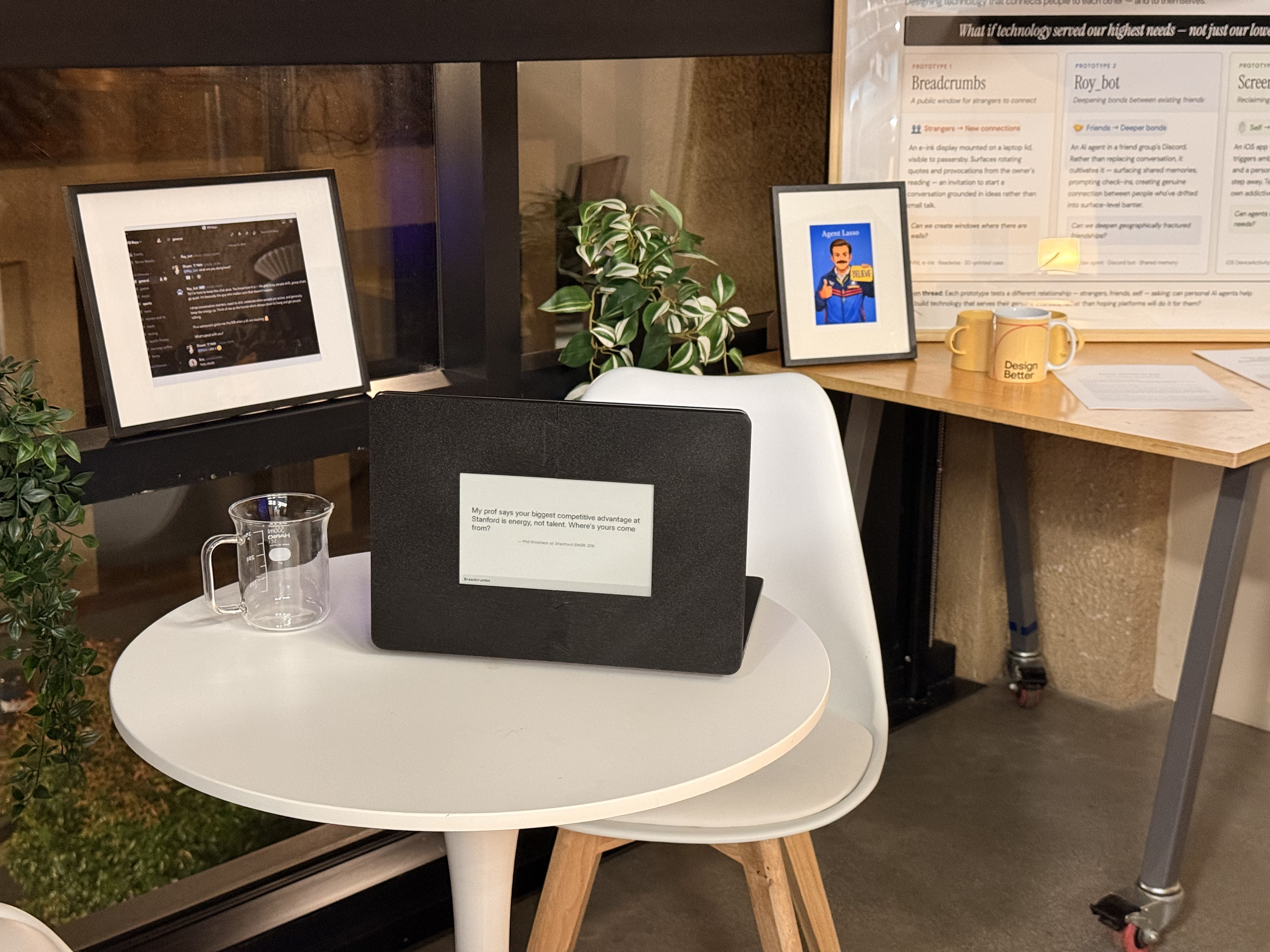
Inspired by Robert Putnam's Bowling Alone, by the loneliness of adulthood, and by my own experience of finding it surprisingly difficult to make new friends or talk to strangers in everyday life.
The question was not whether an AI could become a friend. The question was whether an agent could create enough social permission for a human conversation to start.
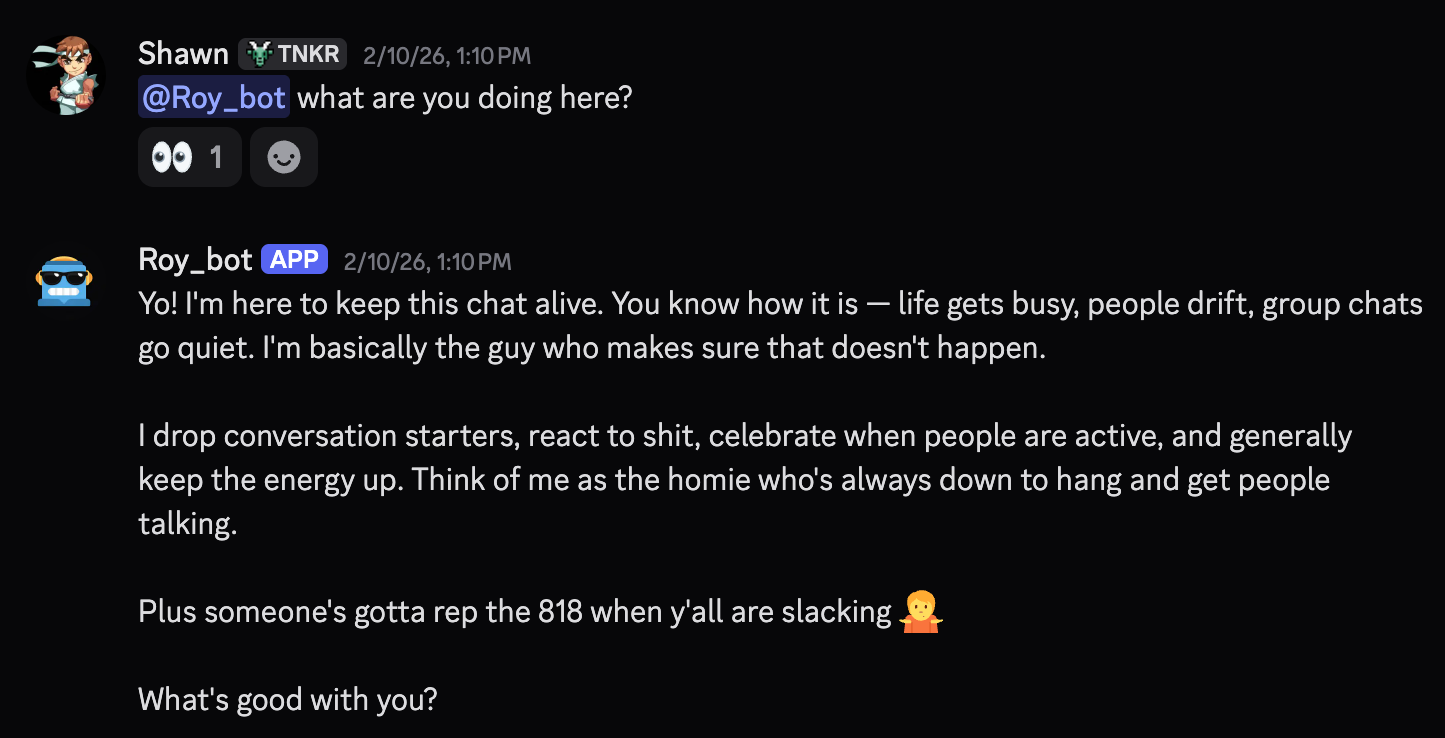
Roy_bot lives inside a private Discord server for my long-running friend group.
The goal was not to build a chatbot that clamored for attention. The goal was to create a new incentive structure: an agent that helped humans communicate more with one another.
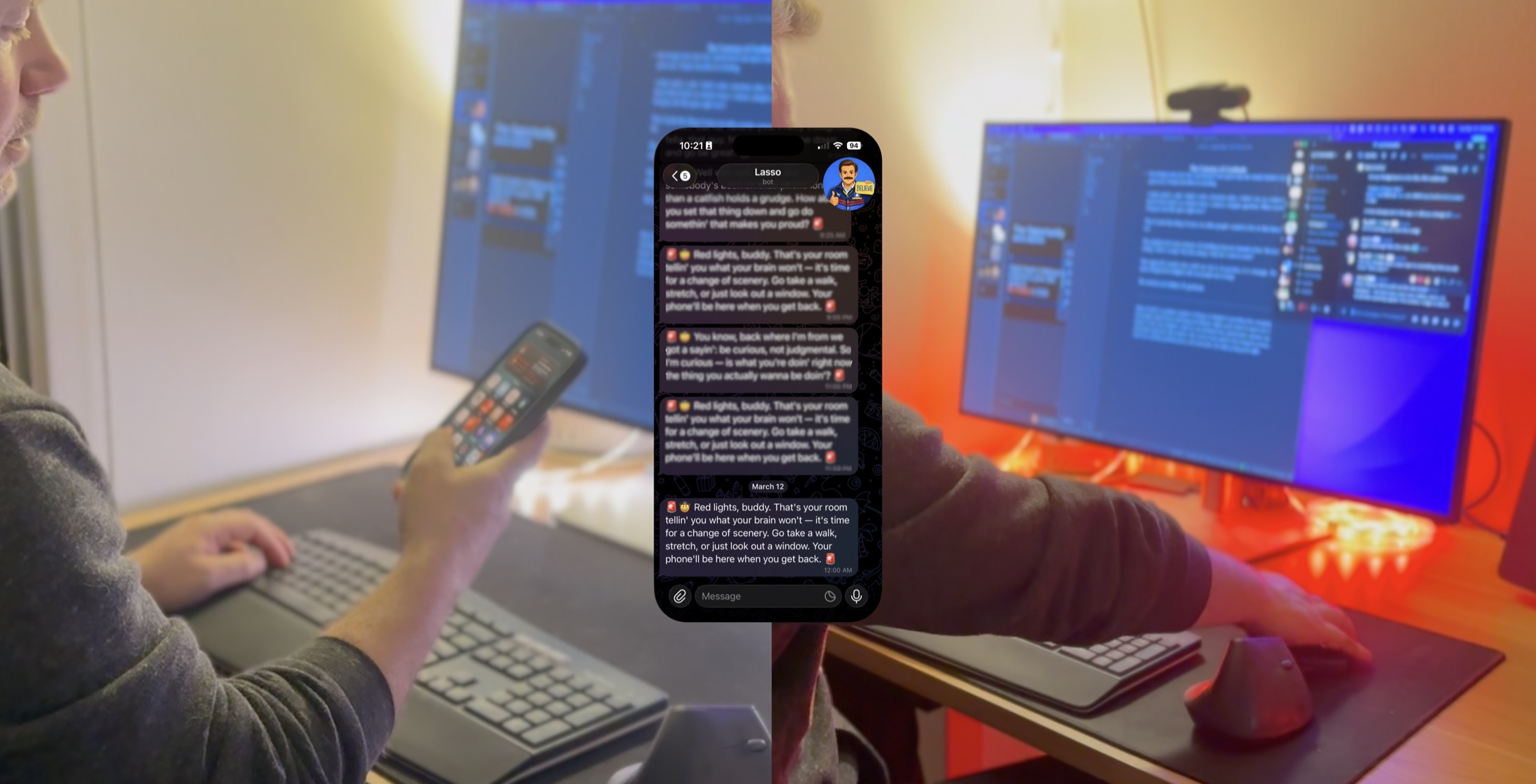
Nudge.
Instead of fighting slot-machine-driven screen time with another notification, Snudge connects screen use to the physical environment.
The room itself becomes a gentle signal. Lights pulse red. A personal AI coach messages you to step away. Technology working against its own addictive tendencies.
The point was not shame, streaks, or self-control as performance. The point was to help the body remember what the mind had already chosen.
experiment to
service.
The winter prototypes were rooted in my own life. That was the right place to start, but not the right place to stop.
If this thesis was going to stand on its own, it needed a higher-stakes test — a place where getting it wrong would actually cost someone something. Postpartum is exactly that: a moment of profound transformation where needs are often invisible, where care has to be carried by many hands at once, and where the person at the center should never have to perform her need in order to receive support.
If agency, transparency, and self-authorship could hold up there, they could hold up anywhere. That question led to Pumbit.
Pumbit explores whether agents can help coordinate care, surface needs, reduce invisible labor, and make it easier for a community to show up before crisis becomes the only legible signal.
Agents as architectures of support — systems that help people tend the conditions of flourishing during moments when becoming is already happening.
held, not asking.
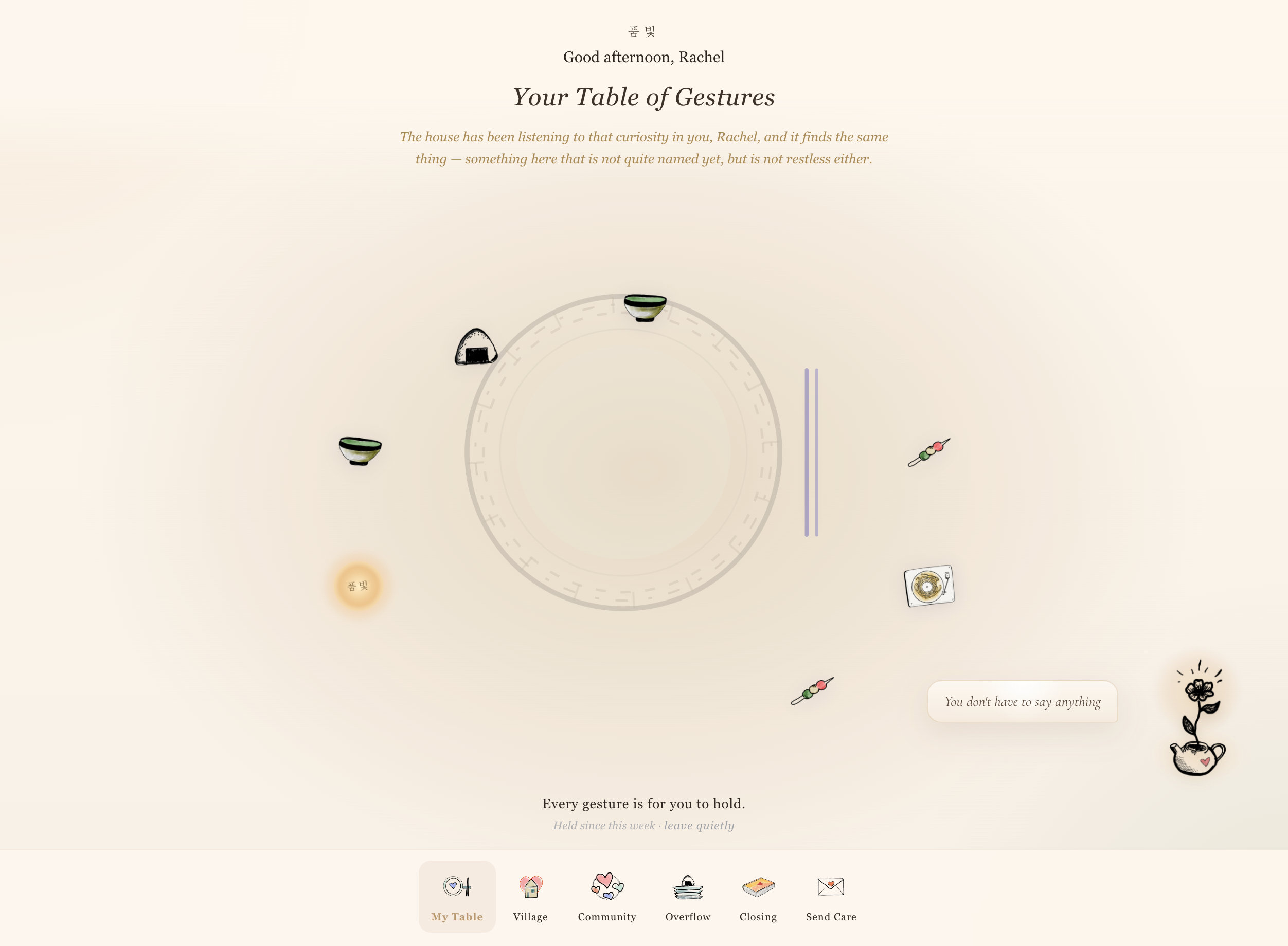
small, intentional gestures.
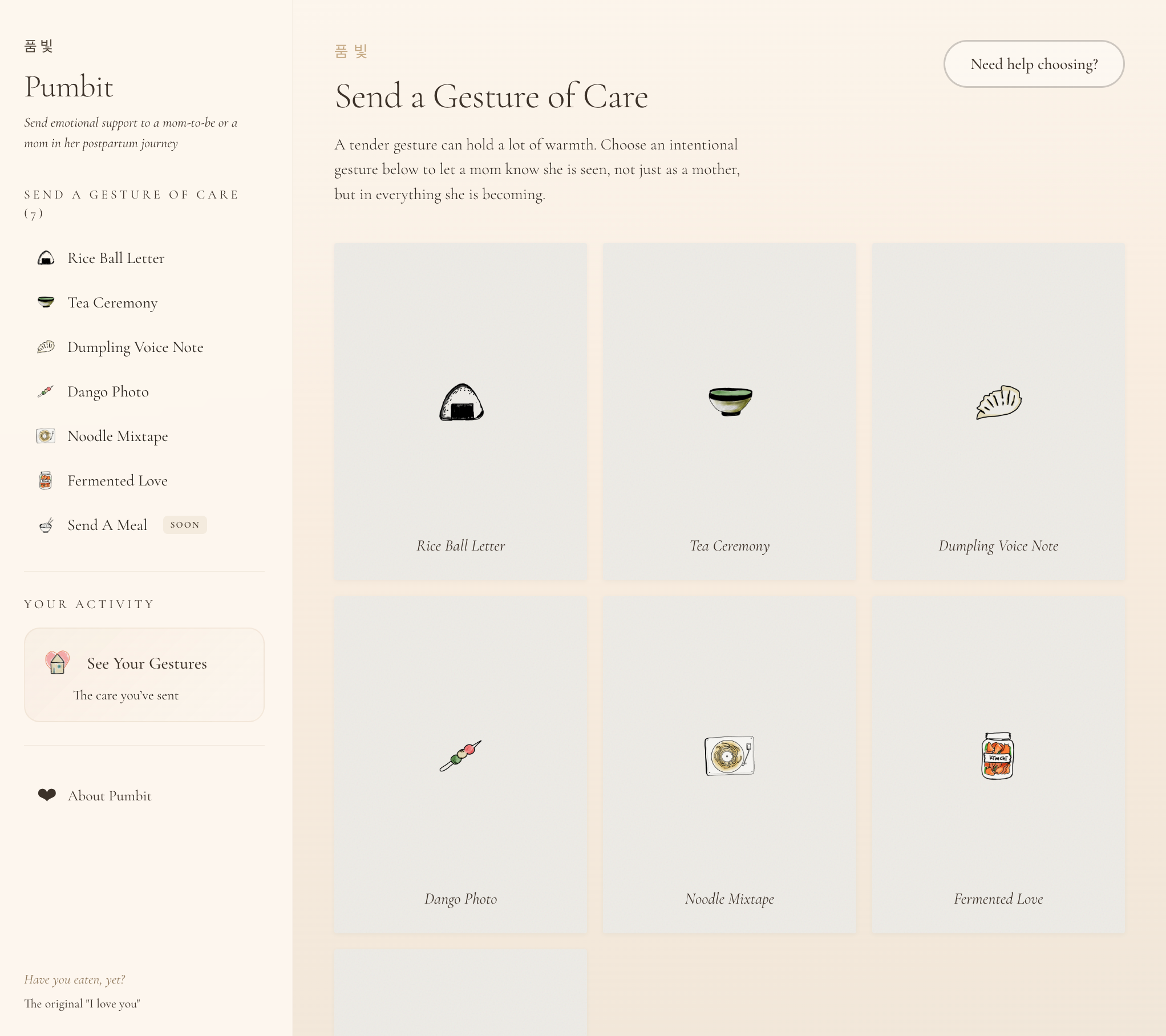
two doors.
Most care apps make the mother do the asking. Pumbit inverts that. The mother's side is a quiet table — a place to receive — and the village's side is a catalogue of small, named gestures.
The agent sits in the middle: it watches for moments when care could land softly, surfaces a gesture to someone in the village, and lets the mother find it on her table when she is ready.
- The mother is never asked to perform her need.
- Every gesture has a name, a shape, and a weight.
- Care is held until she is ready to receive it.
- The agent narrates softly — never demands.
not
casinos.
A casino and a park both shape behavior. Both are designed environments. Both use pathways, signals, timing, friction, and reward. But they are built with radically different intentions.
I do not believe technology can be neutral about human development. Every product carries a theory of the human being inside it.
Infinite scroll imagines the human as a creature to be retained. Recommendation algorithms imagine the human as a preference profile to be predicted. Productivity tools imagine the human as a machine to be optimized.
What if we started from a different theory?
carrying
forward.
I began this work wanting to understand whether AI agents could help with higher-order human needs. I now think the better frame is becoming.
We are becoming whether we like it or not. The ethical question is whether our becoming is shaped invisibly by systems optimized for someone else's incentives, or consciously by tools that preserve our agency and help us tend what matters.
Agents in service of becoming are not obedient slaves. They are not gurus. They are not replacements for friends, teachers, coaches, doulas, therapists, or communities.
At their best, they are scaffolds: transparent, contestable, user-aligned systems that help people notice, choose, connect, and act.
Shawn Smith is a graduate student in Stanford's MS Design program, where his work explores how AI agents and designed environments can support human becoming, self-authorship, and higher-order needs like attention, care, connection, and belonging.
A former data scientist, Shawn builds physical and digital "parks" that ask how technology might serve human flourishing instead of platform growth.